Payments, Billing & Card Authorization
Deposits, balances, storage billing, and signed card authorizations — all on the same record as the move, processed through Stripe or Authorize.Net.
How Payments Work Here
Money problems in this business are record-keeping problems. Keeping payments on the move record fixes most of them.
1. Connect Stripe or Authorize.Net
Use the processor you already have. Each company connects its own merchant account, cards go into a secure vault, and charges run through your processing — not some middleman's.
2. Capture authorization with a signature, not a fax
Credit card authorization is captured together with a signed document packet. When a charge gets questioned months later, you pull up the authorization and the customer's signature on the same record — not a paper form somebody hopefully filed.
3. Deposits and balances stay on the move
Charge the deposit at booking; the balance updates on the booked estimate automatically. Sales, dispatch, and the crew chief all see the same numbers, because there is only one record. Final payment closes out the same estimate the lead started on.
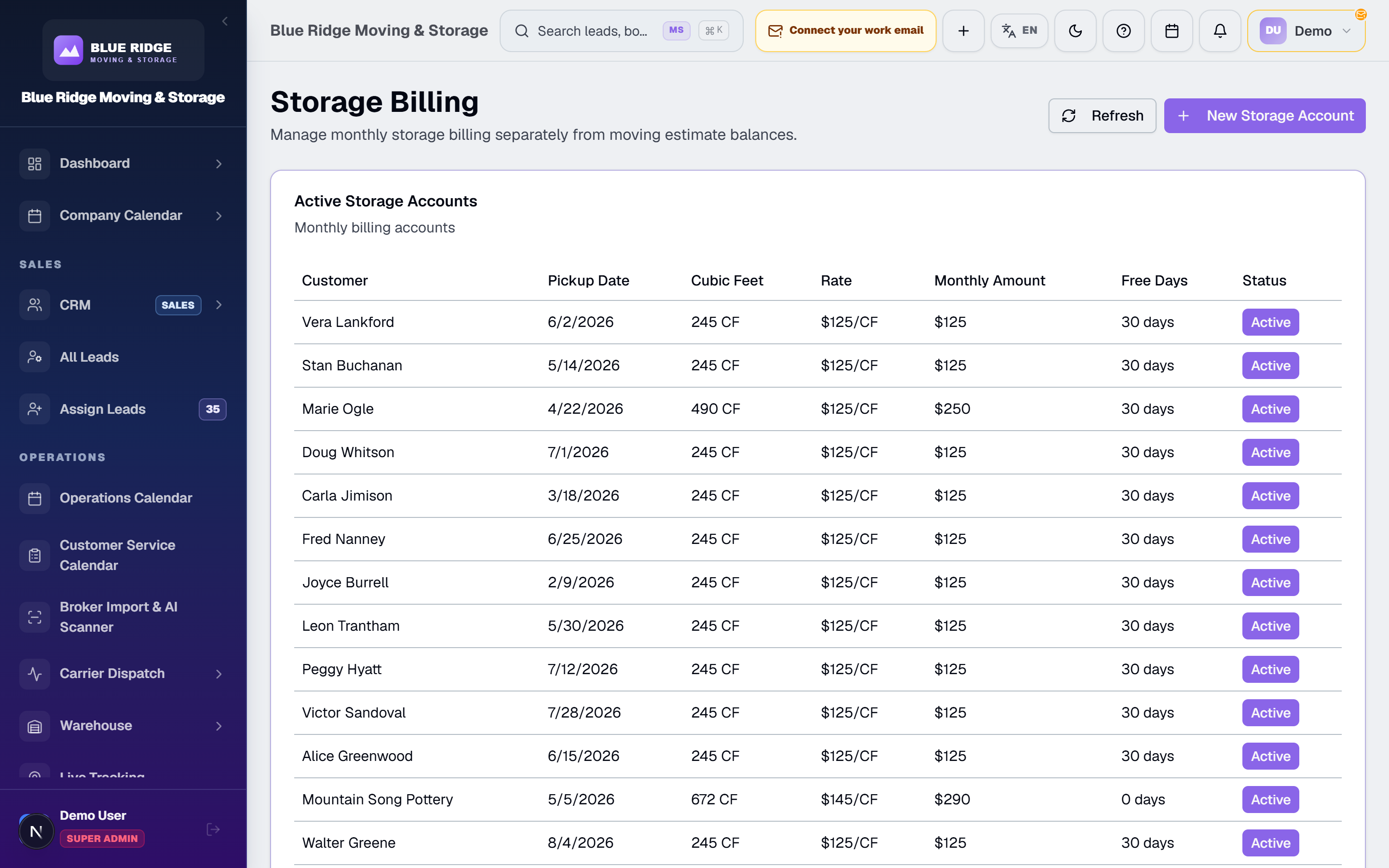
4. Storage billing runs off the same vault
Storage is billed in 30-day cycles on the customer’s statement, and your team collects it inside the platform: charge the card on file or email a payment link capped at the storage balance. The storage account, the card, and the billing history sit with the same customer record as the original move — no separate invoicing tool.
Why It Beats the Fragmented Setup
A processor portal here, a spreadsheet there, paper authorization forms in a drawer — that is how balances get missed and disputes get lost.
The Fragmented Setup
- ✕Card numbers written on paper authorization forms
- ✕Deposits in the processor portal, balances in a spreadsheet
- ✕Storage invoices generated by hand every month
- ✕Disputes with no signed authorization attached to the charge
movingstorageapp.com
- ✓Cards stored in a secure vault via Stripe or Authorize.Net
- ✓Deposits and balances live on the booked estimate record
- ✓Storage cycles on the customer’s statement, collected inside the platform
- ✓CC authorizations captured with a signed document packet
Payment Questions, Answered
Which payment processors are supported?
Stripe and Authorize.Net. Each company connects its own merchant account, so your money settles to your bank under your existing processing relationship.
How does card authorization work for moves?
The customer completes a credit card authorization tied to a signed document packet — the authorization and the signature travel together as one record. Cards are stored in a secure vault for charging deposits and balances, not on paper forms in a filing cabinet.
How are deposits and balances tracked?
On the booked estimate itself. The deposit, payments, and remaining balance live on the same record as the move, so the office and the crew see the same numbers. Final payment closes out the same record the lead started on.
Can I bill storage customers on a schedule?
Yes. Storage is billed in 30-day cycles from the booked estimate, and each cycle is added to the customer’s storage statement. Your team charges the card on file or emails a payment authorization link capped at the storage balance, through the same Stripe or Authorize.Net processing. No card is charged automatically, and no separate invoicing tool is needed.
One Record From Deposit to Final Payment
See a deposit charge, a signed CC authorization packet, and storage billing in a live demo. Full payments and card on file come with Professional and Enterprise, from $599 a month. Carrier: balance collection only.